




What is PNL? It is one of the most fundamental concepts every trader must understand before investing. Whether you trade stocks, forex, crypto, or commodities, the PNL figure acts as a compass that tells you directly whether your strategy is working. Many people still wonder what PNL is, what P&L stands for, and what PNL on Binance means. This article explains everything in detail, with formulas and real worked examples in dollar figures.
What Is PNL? The Meaning of P&L in Trading and Investing
PNL is the abbreviation of Profit and Loss — the figure that shows the financial result of your trading or investment activity over a given period of time. If PNL is positive, you are in profit. If it is negative, you are at a loss.
In the world of trading and investing, PNL is not limited to the forex or crypto market. It is used universally across all markets — stocks, bonds, and commodities alike. Every trader must understand PNL as a foundational concept.
What Does P&L Stand For and Where Does the Term Come From
P&L stands for Profit and Loss. It is sometimes written as PnL or PNL, and all three versions carry exactly the same meaning. In accounting, P&L refers to the Income Statement — the financial report that summarises all of a company’s revenues, costs, and expenses over a reporting period. In trading, PNL is the number that tells you how much profit or loss a single trade or your overall account has generated.
A Simple Example That Explains How PNL Works
Suppose you have starting capital of $1,000 and you decide to trade a stock.
| Scenario | Purchase price | Sale price | Number of shares | PNL |
| Profit | $14.50 | $16.20 | 500 | +$850 |
| Loss | $14.50 | $13.00 | 500 | −$750 |
| Break even | $14.50 | $14.50 | 500 | $0 |
The table shows that PNL is calculated from the difference between the sale price and the purchase price, multiplied by the number of units. This single calculation tells you exactly how much you gained or lost on any given trade.
How to Calculate PNL — Formula and Real Examples
The basic PNL formula works across every market and asset class.
PNL = (Sale price − Purchase price) × Number of units
PNL % = (PNL ÷ Total capital invested) × 100
Net PNL = Gross PNL − Commission − Platform fees − Tax (where applicable)
For example, to calculate PNL on a stock trade:
- Purchase price: $35 per share
- Sale price: $40 per share
- Number of shares: 1,000
- Commission: $50
- Gross PNL = (40 − 35) × 1,000 = $5,000
- Net PNL = 5,000 − 50 = $4,950
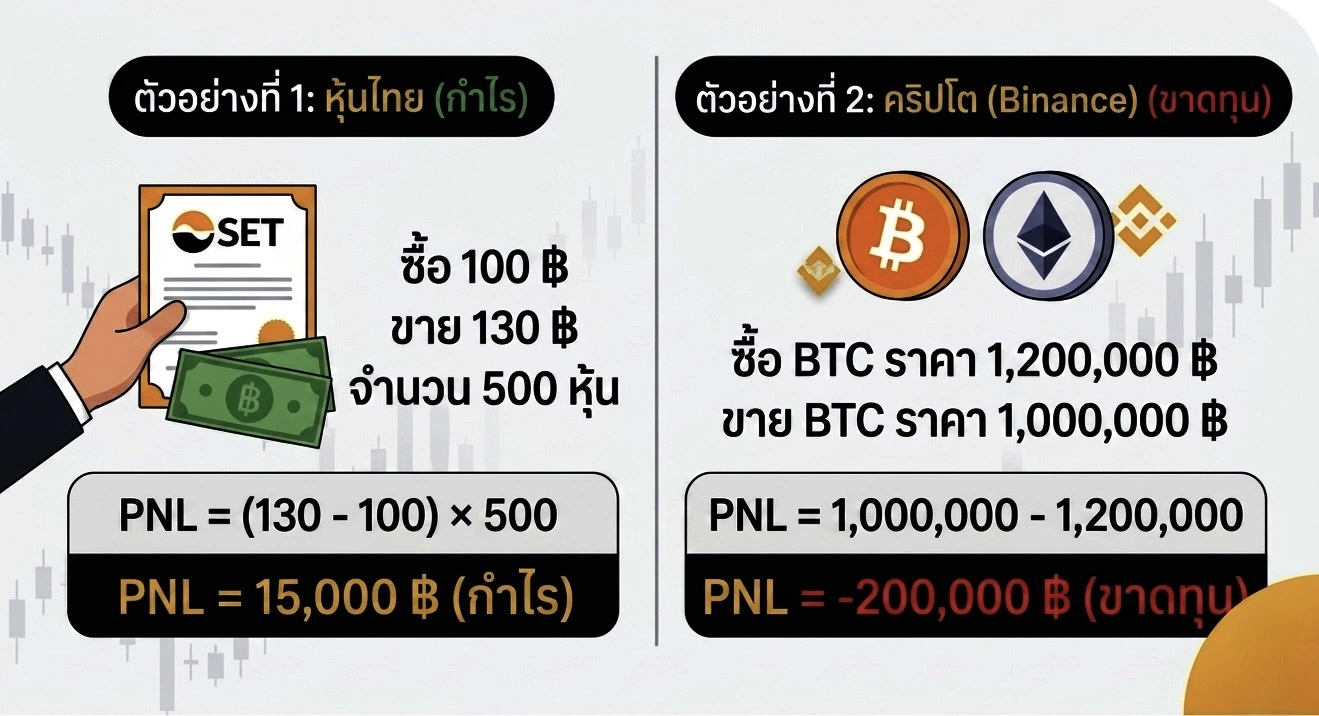
Example 1: Calculating PNL on a Stock Trade
Suppose you trade shares on your local stock exchange.
- Purchase price: $14.50 per share
- Sale price: $16.20 per share
- Number of shares: 500
- Commission: $35
- Gross PNL = (16.20 − 14.50) × 500 = $850
- Net PNL = 850 − 35 = +$815 (profit)
- PNL % = (815 ÷ 7,250) × 100 = +11.24%
Example 2: Calculating PNL on a Crypto Trade (Binance)
Suppose you trade Ethereum (ETH) on the Binance platform.
- ETH purchase price: $2,100
- ETH sale price: $1,960
- Amount: 0.5 ETH
- Binance fee: approximately 0.1%
- Gross PNL = (1,960 − 2,100) × 0.5 = −$70
- Net PNL after fee deduction ≈ −$72.03 (loss)
- PNL % ≈ −6.86%
What Is Realized PNL and Unrealized PNL
PNL is divided into two main types that every trader must understand clearly.
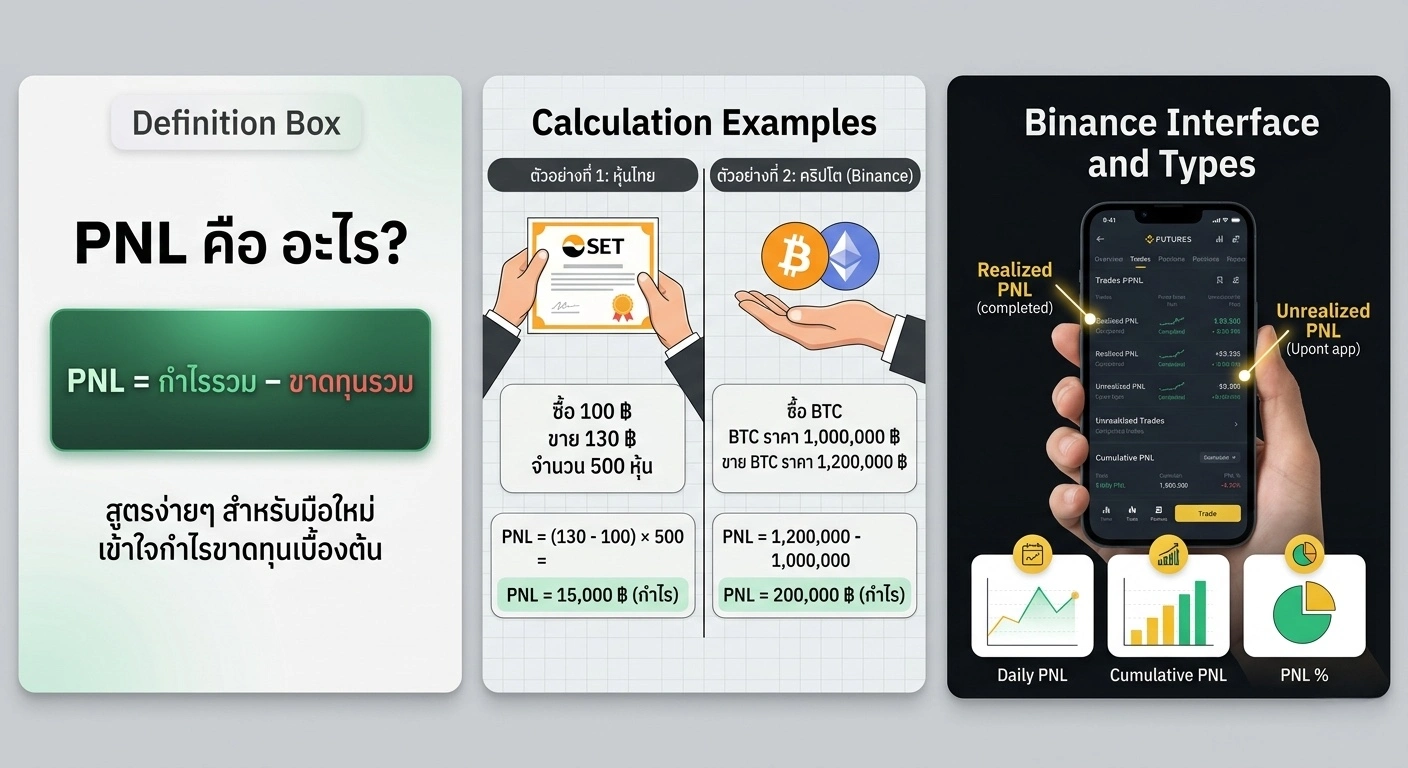
Realized PNL is the profit or loss that has actually occurred after you close a position. Once an order is closed, this figure is locked in and does not change. It is confirmed, real money gained or lost.
Unrealized PNL is the profit or loss on a position that is still open. This figure fluctuates in real time as the market price moves and can swing from positive to negative at any moment.
| PNL type | Meaning | Order status | Example |
| Realized PNL | Confirmed profit or loss | Position closed | You sold your shares and received +$500 in your account |
| Unrealized PNL | Floating profit or loss | Position still open | You are holding shares that have risen — your portfolio shows +$300, but you have not sold yet |
Caution: Unrealized PNL can become a Realized loss if the market reverses before you close the position. Never count floating gains as money in the bank.
What Is PNL on Binance? How to Read PNL on the Binance Platform
PNL on Binance is the profit and loss figure displayed inside your Binance account. Binance is the most widely used crypto trading platform globally. The Binance PNL display system works as follows.
- Spot Trading — view PNL for closed trades at Wallet → Spot → Transaction History → Trade
- Futures Trading — the Futures page shows Unrealized PNL in green or red for open positions, plus the Realized PNL for the current month
- Asset page → PNL Analysis — view a summary of daily, weekly, and monthly PNL with a cumulative returns chart
How Is PNL Calculated on Binance? (USDT to USD Example)
Suppose you are trading BTCUSDT on Binance Futures.
- Open a Long BTC position at $30,000
- Close the position at $33,000
- Position size: 0.1 BTC
- PNL (USD) = ($33,000 − $30,000) × 0.1 = $300
Note: exchange rates between USDT and your local currency change every day. Always check the official rate from your country’s central bank on the date of the transaction for accurate tax reporting.
PNL on Binance vs Other Platforms
| Platform | PNL currency | Where to find PNL | PNL types shown |
| Binance | USDT / BTC / traded asset | Futures Panel / Asset History | Realized + Unrealized |
| Coinbase | USD | Portfolio page | Current portfolio value |
| TradingView | Currency of connected account | Paper Trading PNL | Realized + Unrealized |
| Stock brokers (general) | Local currency | Portfolio page | Cumulative profit and loss |
Types of PNL Every Trader Should Know
PNL comes in several forms, each measuring a different dimension of trading performance. A disciplined trader tracks all of them.
Daily PNL — Profit and Loss for the Day
Daily PNL is the total of all gains and losses from every order closed on a given day. It is used to track daily trading results and compare performance between sessions. Day traders should record their Daily PNL every single day to evaluate performance objectively.
Cumulative PNL — Total Profit and Loss Over Time
Cumulative PNL is the running total of all Daily PNL figures since you started trading. It is the most important number for judging whether a strategy actually works over the long run. If your Cumulative PNL trends consistently upward, your strategy is working.
PNL % — Return as a Percentage
PNL % expresses the return relative to capital invested, making it possible to compare performance fairly across trades of different sizes. Earning $50 on a $500 trade (PNL 10%) is a better result than earning $100 on a $5,000 trade (PNL 2%).
| PNL type | Formula | What it measures | How often to track |
| Daily PNL | Sum of all closed trade PNL for the day | Daily performance | Every trading day |
| Cumulative PNL | ∑ of all Daily PNL figures | Long-term strategy results | Monthly or annually |
| PNL % | (Net PNL ÷ Capital invested) × 100 | Return relative to capital | Per trade |
| Unrealized PNL | (Current price − Entry price) × Units | Live portfolio value | Real-time |
PNL for Beginners — How to Use PNL to Improve Your Trading
For a beginner, PNL is not just a number — it is a direct reflection of your decision-making. Tracking it consistently gives you honest feedback that no amount of gut feeling can replace.
Why PNL Matters for New Traders
- It tells you whether your strategy works. If your cumulative PNL is consistently negative, the strategy needs to change
- It keeps emotions out of decisions. Looking at trades as numbers helps you make rational choices instead of reactive ones
- It guides your money management. Knowing your PNL trend tells you whether to add capital or step back and review first
How to Track Your PNL Every Day — The Trading Journal
A Trading Journal is the tool that separates serious traders from gamblers. Every professional trader uses one. Record the following information for every trade you take.
| Field | Example |
| Date and time | 17 May 2025, 10:30 AM |
| Asset traded | BTC/USDT or Apple stock |
| Entry price | $30,000 |
| Exit price | $32,000 |
| Position size | 0.05 BTC |
| Net PNL | +$100 |
| Reason for entering | Breakout above resistance level |
| Lesson learned | Wait for confirmation candle before entering |
Common PNL Mistakes That Beginners Make
- Forgetting to deduct commission and fees, which makes the actual profit look higher than it really is
- Confusing Unrealized PNL with Realized PNL and counting floating gains as income before the position is closed
- Not setting a Stop Loss, which allows losing trades to drag PNL deeply negative
- Watching PNL too frequently and overtrading in an attempt to recover losses
- Failing to record trades in a journal, making it impossible to identify patterns in wins and losses
PNL and Tax — What Traders Need to Know
Before trading in any market, it is important to understand the tax obligations that apply to your trading profits.
Risk Warning: The following is general information only and does not constitute tax or legal advice. Consult a qualified professional for guidance specific to your circumstances.
Are Trading Profits Taxable
In most countries, profits from trading are treated as taxable income. The applicable rules depend on your country of residence, the asset class traded, and your classification as a retail or professional trader. General principles that apply in many jurisdictions include the following.
- Gains from stock trading are often subject to capital gains tax or income tax depending on the holding period
- Crypto trading profits typically require self-reporting to the relevant tax authority
- Total investment income is usually combined with other income when calculating your overall tax liability
- Always keep detailed records of every trade so your PNL can be reported accurately
Regulatory Oversight of Trading Platforms
Before depositing funds on any trading platform, verify that it holds a valid licence from the appropriate financial regulator in your jurisdiction. Trading with an unregulated platform carries significantly higher risk, including the risk that funds cannot be recovered in the event of a dispute.
Important: Many offshore platforms offering Binary Options are not licensed or regulated by major financial authorities. Always check the regulatory status of any platform before depositing funds.
How to Report Your Trading PNL for Tax Purposes
- Gather your full-year PNL records by exporting trade history from your platform in CSV or PDF format, with net profit figures clearly stated
- Convert any foreign currency amounts to your local currency using the official central bank exchange rate on the date of each transaction
- File your tax return by the applicable deadline in your country — consult your national tax authority’s website for the correct forms and deadlines
- Consider consulting a qualified accountant, particularly if you trade crypto, as tax rules in this area continue to evolve
Tools for Tracking PNL
Choosing the right tools makes it easier to monitor your PNL accurately and consistently.
Popular PNL Tracking Tools
| Tool | Best for | Cost | Notes |
| TradingView | Stocks, crypto, forex | Free (Pro plans available) | No |
| Binance Portfolio | Crypto on Binance | Free | Built-in PNL analysis |
| SET Smart / Streaming | Local stock markets | Partly free | Yes (where available) |
| Google Sheets template | Any asset class | Free | Fully customisable |
| Cointracker / Koinly | Crypto tax reporting | Free tier available | Cross-exchange tracking |
How to Use Stop Loss to Protect Your PNL
Stop Loss is the single most important tool for protecting your PNL from catastrophic losses. The basic principles every beginner should follow are listed below.
- The 1-2% rule — never risk more than 1-2% of your total capital on a single trade. If you have $5,000, your Stop Loss should limit the loss on any one trade to no more than $100
- Risk:Reward Ratio of at least 1:2 — set your Take Profit target at a minimum of twice the distance of your Stop Loss
- Set the Stop Loss before you open the trade — never place a trade without knowing in advance exactly where you will exit if you are wrong
- Never move your Stop Loss further away — if the market moves against you, resist the temptation to widen the Stop Loss. That turns a small loss into a large one
Summary — PNL Is the Core of Successful Trading
PNL is a mirror that reflects your trading ability with complete honesty. No matter how confident you feel about your skills, your cumulative PNL over time tells the truth.
For beginners, the right approach is to learn the PNL formula, record every trade in a journal, use a Stop Loss on every position, and never risk more than 1-2% per trade. As experience grows, strategy can become more sophisticated — but even the most professional traders treat risk management as the priority, not the pursuit of maximum profit.
Key points to remember from this guide.
- PNL stands for Profit and Loss, calculated as (Sale price − Purchase price) × Number of units
- P&L, PnL, and PNL all mean exactly the same thing
- PNL on Binance is split into Realized PNL (closed positions) and Unrealized PNL (open positions)
- Realized PNL is locked in once a trade closes; Unrealized PNL changes in real time and can reverse
- Trading profits are taxable in most countries — keep records and consult a professional
- Always verify a trading platform’s regulatory status before depositing funds
Frequently Asked Questions About PNL
What is PNL, explained simply
PNL is the abbreviation of Profit and Loss. It is the figure that tells you how much money your trading or investment activity has made or lost over a given period. The basic calculation is: (Sale price − Purchase price) × Number of units. A positive PNL means you are in profit; a negative PNL means you are at a loss.
What does P&L stand for
P&L stands for Profit and Loss. Some traders write it as PnL or PNL — all three mean exactly the same thing. In accounting, the same concept is called the Income Statement or Profit and Loss Statement.
What is PNL on Binance and how do you read it
PNL on Binance shows the profit and loss from your trading activity on the platform. It is split into Realized PNL, which covers positions that have already been closed, and Unrealized PNL, which covers positions that are still open. You can view both on the Futures Trading page or in the Asset History section.
How do you calculate PNL in crypto trading
Use the formula: PNL = (Sale price − Purchase price) × Number of coins. For example, if you buy BTC at $30,000 and sell at $36,000 with a position of 0.1 BTC, your PNL is (36,000 − 30,000) × 0.1 = $600. Remember to deduct platform fees of approximately 0.1% per side on Binance.
What does a negative PNL mean
A negative PNL means your sale price was lower than your purchase price — you took a loss on the trade. When PNL turns negative, review what went wrong, check whether your Stop Loss was set correctly, and resist the urge to increase your position size to try to recover the loss quickly.
Do trading profits have to be declared for tax purposes
In most countries, yes. Profits from trading are generally treated as taxable income. The specific rules depend on your country, the asset class, and your trading frequency. Always keep detailed records and consult a qualified tax adviser.
What is the difference between Realized and Unrealized PNL
Realized PNL is the profit or loss that is confirmed and locked in after you close a position. It does not change. Unrealized PNL is the floating profit or loss on a position that is still open. It changes every second as the market price moves and can shift from positive to negative at any moment.
What is a realistic PNL target for a beginner trader
For beginners, the realistic goal in the first year is not to get rich — it is to avoid losing a significant amount of capital while learning the market. A useful benchmark is a Win Rate of 50-55% combined with a Risk:Reward Ratio of 1:2, which produces positive cumulative PNL over the long run even when nearly half of individual trades are losers. Do not compare yourself to people posting gains on social media — they rarely show the losing trades.
Risk Warning: This article is for general informational purposes only and does not constitute financial or investment advice. Trading involves significant risk and you may lose all of your invested capital. Always conduct thorough research and consult a qualified professional before making any trading or investment decision.
You may also be interested in:









Leave A Comment