




The Th-Option team has compiled information about swap values in the forex market in this article. If you’ve ever opened a position overnight and seen strange numbers appear in your account, that’s swap. This value can be positive or negative, and it genuinely affects your profit and loss. This article explains everything from the basics to how to use swap to your advantage.
What Is Forex, and Why Does Swap Matter?
What is forex? Many people know it as the world’s largest foreign currency exchange market, with a daily trading volume in the trillions of dollars. This market is open 24 hours a day, 5 days a week, which means your positions can remain open overnight.
That’s exactly where swap comes into play. When you hold a position past midnight (your broker’s server time), the broker will charge or pay you interest based on the interest rate differential between the two currencies in that pair. It’s not a hidden fee — it’s a standard mechanism of the financial markets.
What Is a Swap? A Simple Explanation
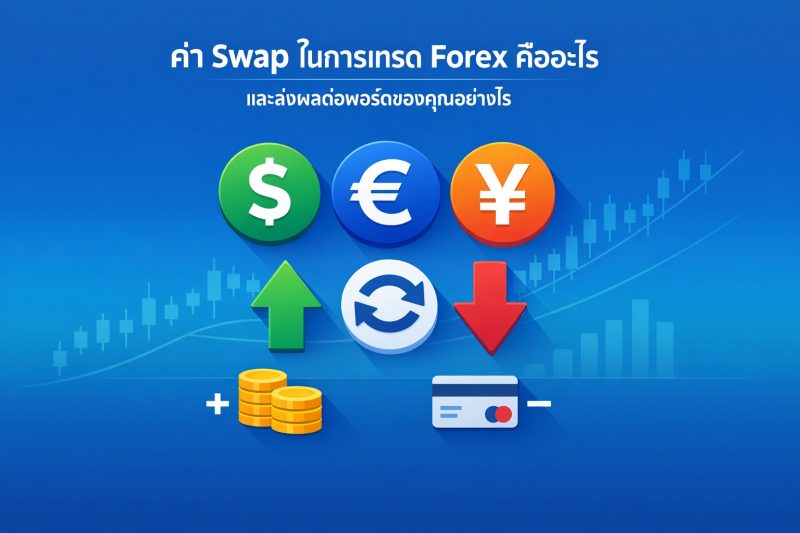
What is a swap value? In the simplest terms, it’s the interest that arises from holding a position overnight. Since forex trading involves buying one currency and selling another simultaneously, the interest rates of the two countries differ — and that difference is the source of the swap.
For example, with the EUR/USD pair: if you buy EUR and the EUR interest rate is lower than USD, you will receive a negative swap. But if you sell EUR and buy USD, you may receive a positive swap instead, depending on the swap rate set by your broker on that day.
| Swap Type | Meaning | Effect on Account | When It Occurs |
| Positive Swap | Interest received from the broker | Money added to account every night | Buying the currency with the higher interest rate |
| Negative Swap | Interest deducted from the account | Balance decreases every night the position is held | Buying the currency with the lower interest rate |
| Zero Swap | No swap charged or paid | No effect | Swap-free account, or when rates are exactly equal |
Swap Long and Swap Short: What’s the Difference?
Forex swap comes in 2 forms: swap long and swap short, corresponding to the direction of the position you’re holding. Swap long is the value that occurs when you hold a long position, or buy a currency pair overnight. Swap short occurs when you sell.
Both swap long and swap short can be positive or negative, depending on the interest rates of the countries involved. For example, the AUD/JPY pair often yields a positive swap on the long side because AUD has a considerably higher interest rate than JPY.
| Currency Pair | Swap Long (Buy) | Swap Short (Sell) | Notes |
| EUR/USD | Negative (generally) | Positive or negative | Depends on ECB/Fed differential |
| AUD/JPY | Positive (generally) | Negative | AUD interest rate much higher than JPY |
| USD/JPY | Positive (generally) | Negative | USD interest rate higher than JPY |
| EUR/JPY | Depends on ECB policy | Depends on ECB policy | Changes with European interest rate direction |
| GBP/USD | Negative or positive | Negative or positive | Fluctuates with BoE/Fed policy |
In practice, before opening a position you intend to hold for several days, always check the swap in your platform first. Some brokers display swap as pips per lot; others display it as a monetary value per standard lot per night.
How to Calculate Forex Swap — Can You Do It Yourself?
The swap calculation method isn’t overly complicated. The basic formula is: (lot size × contract size × swap rate × number of nights) / 360 or 365, depending on the instrument. However, most brokers calculate it automatically.
A simple example: suppose you’re trading EUR/USD at 1 lot (100,000 units). If the swap rate is –0.5 pip per night, the swap calculation gives you approximately –$5 USD per night. Hold for 10 nights and you’ve lost $50 USD from swap alone, not counting spread or commission.
| Lot Size | Units | Example Swap/Night (at –0.5 pip) | Swap over 10 Nights |
| Standard Lot (1.0) | 100,000 | Approx. –$5.00 USD | –$50.00 USD |
| Mini Lot (0.1) | 10,000 | Approx. –$0.50 USD | –$5.00 USD |
| Micro Lot (0.01) | 1,000 | Approx. –$0.05 USD | –$0.50 USD |
Negative Swap: How Does It Impact Your Trading?
Negative swap is something most traders encounter, especially when holding a long position on a pair where the first currency has a lower interest rate than the second. This amount is deducted from your account every night the position remains open. For short-term, single-day trades you may not notice anything, but if you hold for several weeks, negative swap can eat significantly into your profits.
In the world of forex trading, traders who hold long-term positions must factor swap into their profit and loss planning. It’s a cost many people forget to include. You see the price reach your take profit level, but your actual profit is less than expected because overnight swap has accumulated over many days.
Signs that negative swap is eating into your portfolio:
- Your balance decreases slightly every morning even when price hasn’t moved
- Profit is lower than calculated every time you close a long-term position
- Total cost per trade exceeds the combined spread and commission
- The longer you hold, the more price needs to move to reach breakeven
- Carry trade gains are completely offset by negative swap on the opposite side
What Is Carry Trade, and How Does Swap Relate?
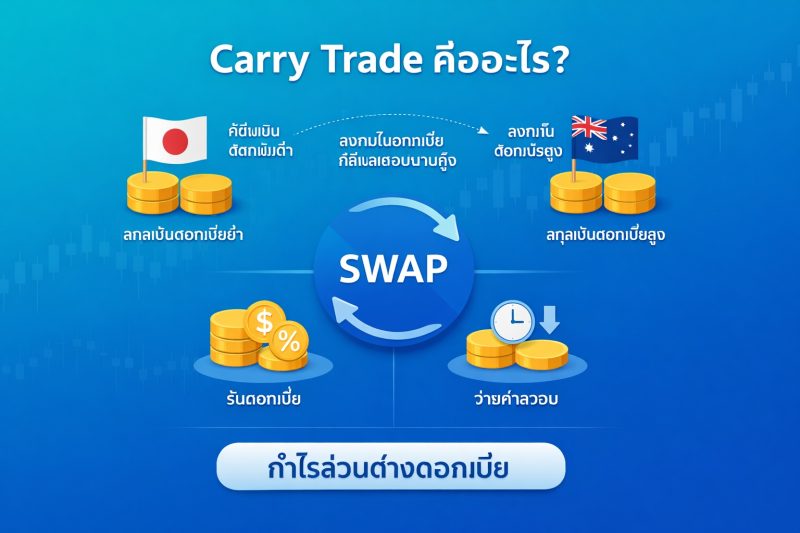
Carry trade is a strategy that directly exploits positive swap. Traders buy a high-interest currency and sell a low-interest currency, then hold the position to accumulate swap over time.
Carry trade is a method widely used by institutional investors. At the retail level it’s also achievable, but you must understand that swap rates can change with central bank policy. If a central bank adjusts interest rates, a previously positive swap can reverse direction.
| Strategy | Suited For | Advantages | Disadvantages |
| Carry Trade (collecting positive swap) | Long-term traders | Steady income every night without waiting for price movement | Price reversal can wipe out swap profits |
| Day Trading (closing before midnight) | Short-term traders | No swap costs at all | Requires more precise market timing |
| Swing Trading (holding several days) | Intermediate traders | Good for catching trends | Swap accumulates; must calculate carefully |
| Scalping | Fast traders | Not affected by swap | Spread and commission are higher |
Popular Brokers and Their Swap Structures
The main factor traders should check before choosing a broker is each broker’s swap structure. The swap in the forex market charged by different brokers is not the same, even when trading the same pair at the same size.
| Broker | Has Swap? | Swap-Free Account? | Best For | Notes |
| Exness | Yes | Yes (Islamic Account) | All trader levels | Clear swap rate display in platform; very popular |
| XM | Yes | Yes (Zero Swap Account) | Beginner–intermediate traders | Occasional time-limited swap-free promotions |
| FBS | Yes | Yes (Islamic Account) | High-leverage traders | Competitive swap rates; verifiable in MT4/MT5 |
| Pepperstone | Yes | Yes (Islamic Account) | Intermediate–advanced traders | Near-market swap rates, low spreads; ideal for carry trade |
| IC Markets | Yes | Yes (Islamic Account) | ECN/Raw spread traders | Competitive swap; suited for scalping and swing trading |
| IQ Option | Partial | Not in standard form | CFD and digital options traders | Not traditional forex; swap applies only to some instruments |
| Exnova | Partial | Depends on account terms | Binary and digital options traders | Swap is not the main focus; check conditions directly |
In summary, if you want to do carry trading or hold long-term forex positions, Exness, Pepperstone, and IC Markets offer the most transparent swap structures. XM and FBS are suitable if you’re just starting out and want a straightforward swap-free account. IQ Option and Exnova focus on a different style of trading where swap is not the primary concern for these platforms.
Swap-Free Accounts: Who Are They For, and How Do They Differ from Regular Accounts?
Swap-free accounts, or Islamic accounts, were designed for traders who have religious restrictions on interest. In these accounts, no swap is charged or paid, but brokers may compensate with another form of fee instead.
Swap is a cost that cannot be ignored, whether you use a standard account or a swap-free account. You must understand what you are paying for in each trade.
Key points before applying for a swap-free account:
- Some brokers charge an overnight administration fee instead of swap, which may be even higher
- Some swap-free accounts restrict the instruments available to trade — not all pairs are included
- There may be limits on lot size or maximum position holding duration
- Some brokers offer swap-free only for trial periods or under special conditions
- Always read the account terms carefully before applying — don’t just look at the word “free”
- The current market has several brokers that genuinely offer swap-free at no cost, but identity verification is required
Key Things to Remember About Swap in Forex Trading
- Swap is the interest generated from holding a position overnight — not a hidden fee
- Swap long and swap short differ based on the direction of the position held
- Negative swap means money is deducted from your account; positive swap means you receive funds
- On Wednesdays, swap is charged at triple rate due to the market’s T+2 settlement system
- Carry trade uses positive swap as the core strategy, but carries price risk
- Swap-free accounts charge no interest, but may include other fee types instead
- Different brokers have different swap rates — compare before choosing
- In long-term forex trading, swap genuinely affects profit and loss and should be included in your trading plan
- AUD or NZD vs JPY pairs often yield positive swap on the long side due to the large interest rate gap
- Use the swap calculator in your platform to estimate costs before opening any long-term position
When Should You Care About Swap — and When Can You Ignore It?
If you’re a day trader who closes positions before midnight every day, swap is not a major concern. But if you regularly hold positions overnight — intentionally or by forgetting — swap is a cost that quietly accumulates and can eat into your profits more than you’d expect.
For traders planning to hold positions for multiple days, always check the swap rate before opening. Choose a broker that displays the information clearly, and always include the swap cost when calculating your breakeven point. It’s not something to fear — you just need to know where it fits in your numbers.
Frequently Asked Questions About Swap
Is Swap Charged Every Day?
Yes, swap is charged every day you hold a position past midnight (the broker’s server time, usually 00:00 GMT+2 or GMT+3), except on Saturdays and Sundays when the market is closed. However, from Wednesday to Thursday swap is charged at three times the normal rate to compensate for the two market-closed days. Traders using a day trading strategy who close all positions before midnight every day will not be charged any swap.
What Is an Islamic Swap-Free Account?
An Islamic account or swap-free account is a trading account with no overnight interest charged or paid. It is designed to accommodate Muslim traders whose religion prohibits receiving or paying interest. However, some brokers charge an administration fee in place of swap, which may be equal to or higher in value than standard swap. Always read the terms carefully before applying.
What Is a Swap Rate?
A swap rate is the rate used to calculate the overnight swap cost, referenced from the interest rate differential between the central banks of the two countries in the currency pair being traded, plus a markup added by the broker as a handling fee. Swap rates differ by broker and by currency pair, and can change when central banks adjust interest policy. They are usually displayed as pips per lot per night, or as a monetary value per 1 lot.
Does FBS Charge Swap?
FBS charges swap like any standard forex broker. Every position held overnight is subject to swap based on each currency pair’s swap rate. FBS offers an Islamic Account specifically for those wishing to avoid swap. FBS swap rates are generally competitive in the market and can be verified directly in the MT4 or MT5 platforms.
What Does Free Swap Mean?
Free swap means no overnight swap is charged or paid for positions held overnight. This occurs in two main cases: a swap-free account type designated by the broker, or when the interest rates of the two currencies are exactly equal so the differential is zero. In practice the second case almost never happens, so free swap in reality almost always refers to an account specifically designed by a broker for this purpose.
Do I Have to Pay Taxes on Trading Profits?
For traders in Thailand, profits from forex trading are considered income that must be included in personal income tax calculations under the law, classified as assessable income. The tax rate depends on your total annual income. However, enforcement in this area is still in development, and trading through overseas brokers has reporting complexities. It is recommended to consult an accountant or tax professional directly for your specific case.
What Is Forex Swap and How Does It Affect FX Trading?
Forex swap is the overnight interest cost arising from holding a position in the forex market, calculated from the interest rate difference between two currencies. FX traders will see the swap value added to or deducted from their account when closing or rolling over a position. It should be considered a key factor when planning to hold a long-term position, because swap can function as either a cost or an income stream depending on the direction of the trade and the interest rates of the currencies involved.
What Does Positive Swap Mean, and Should You Hold or Sell?
When swap is positive, it means the trader receives interest for holding the position overnight. In this case, opening a positive-swap position may be a strategy to generate supplemental income, but you must account for market risk and the base value of the currency. If the goal is long-term investment, holding a positive-swap position may be appropriate. But if you intend to sell (close the position) for short-term profit, consider the fees, spread, and key economic factors before deciding.
Key Factors That Affect Forex Swap, and Advice for Beginners
The key factors that cause swap values to change include central bank interest rates, market yields, currency price movements, and the monetary policy of the countries involved. For beginners, always check the broker’s swap table, note whether swap is positive or negative for the pairs you trade, and remember to include swap in your risk management plan to avoid unexpected costs.
Read more about:







Leave A Comment