




Margin is a key concept that every trader and investor should understand, whether trading Forex, stocks, or crypto. This term appears everywhere in the financial world. Margin is a tool that can increase opportunities but also comes with risks. Th-Option has compiled comprehensive information to help you understand every aspect of margin in detail.
What is Margin? Understanding Margin in the Investment World
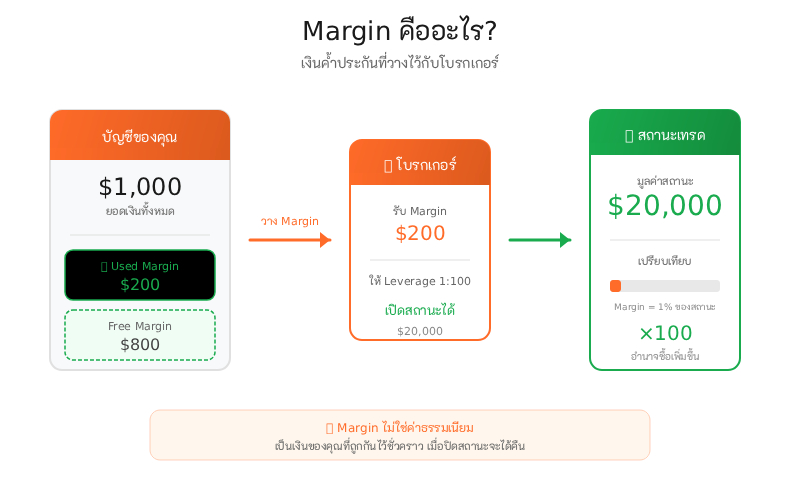
In simple terms, margin is the collateral or deposit you must place with a broker to open and maintain a trading position. Margin literally means “edge” or “difference,” but in trading, it refers to the funds required as a guarantee. “Margin” and “มาจิ้น” mean the same thing; the spelling just varies by pronunciation.
Margin is not a fee or a trading cost. It is your money temporarily held while a position is open. Once the position is closed, these funds are released back to you. Margin is the mechanism that ensures brokers that you have enough funds to cover the risk of your open positions.
In finance, the term margin can have different meanings depending on context. In trading, it refers to collateral. In business, it refers to profit margin. In statistics, it refers to a margin of error. This article will cover all meanings.
How Margin Works in Forex Trading
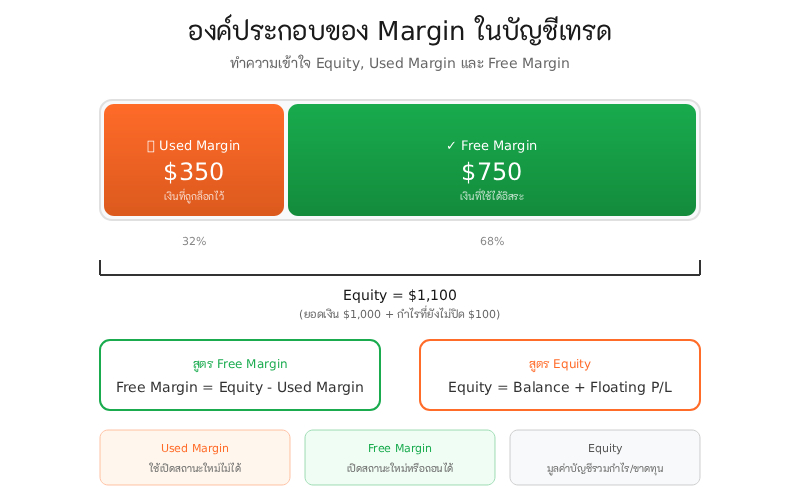
Margin is a key mechanism in Forex trading that allows you to open positions larger than your actual capital. When you open a position, the broker sets aside a portion of your funds as margin, while the rest remains available. Understanding margin levels and its components helps manage risk more effectively.
What is Used Margin?
Used Margin is the amount of money that has been set aside for currently open positions. These funds are “locked” and cannot be used to open new positions or withdrawn until the positions are closed.
For example, if you have $1,000 in your account and open a position that requires $200 margin, your Used Margin is $200. If you open another position requiring $150 margin, the total Used Margin becomes $350.
What is Free Margin and Why It Matters
Free Margin is the amount of money remaining in your account after accounting for Used Margin and including unrealized profits or losses from open positions. These funds can be used to open new positions or withdrawn.
Free Margin formula:
Free Margin = Equity – Used Margin
Where Equity = Account Balance + Unrealized P/L
Free Margin is crucial because it indicates how much capital you have available to withstand market fluctuations. If Free Margin is too low and prices move against you, a Margin Call may occur.
What is Margin Level and How to Use It to Monitor Risk
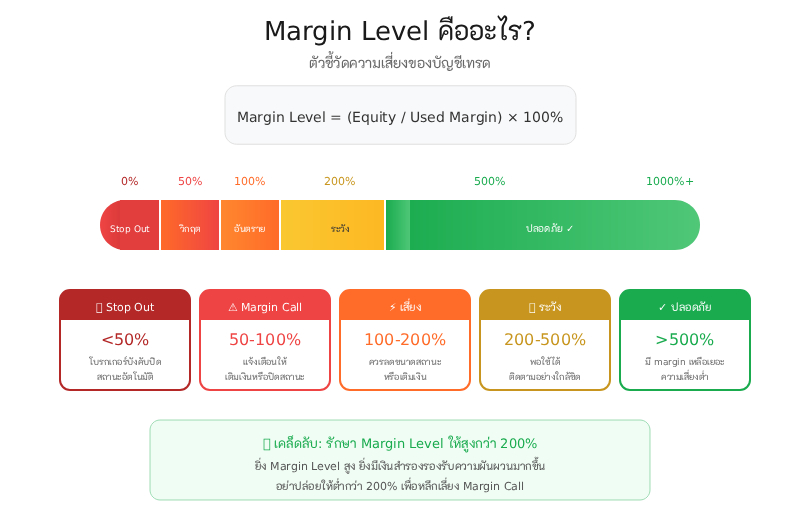
Margin Level is the ratio of Equity to Used Margin, expressed as a percentage. It is a key indicator showing how much risk your account currently holds.
Margin Level formula:
Margin Level = (Equity / Used Margin) × 100%
| Margin Level | Status | Meaning |
| Above 500% | Safe | Ample margin available |
| 200-500% | Moderate | Exercise caution |
| 100-200% | Risky | Approaching Margin Call |
| Below 100% | Danger | Potential Margin Call |
| Below 50% | Critical | Potential Stop Out |
The higher the Margin Level, the safer your account. If the Margin Level falls below the broker’s specified threshold (usually between 50-100%), the broker may force close positions.
How to Calculate Margin in Forex Trading
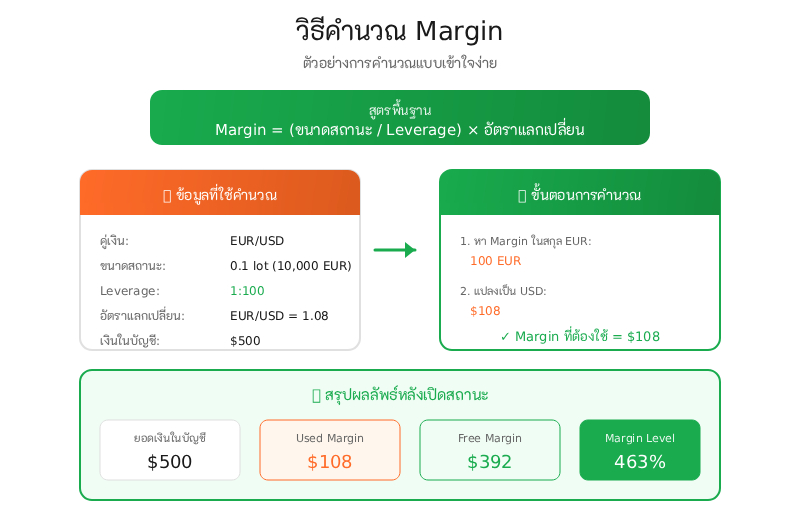
Margin is calculated using a simple formula. Knowing how to calculate it helps you plan your trades better.
Basic formula:
Required Margin = (Position Size / Leverage) × Exchange Rate
For example, if you want to open a 1 lot (100,000 units) position in the EUR/USD pair with 1:100 leverage:
Margin = 100,000 / 100 = 1,000 EUR or approximately 1,080 USD (depending on the exchange rate)
Simple Example of Margin Calculation
Here’s a clearer example:
| Item | Value |
| Currency Pair | EUR/USD |
| Position Size | 0.1 lot (10,000 units) |
| Leverage | 1:100 |
| EUR/USD Exchange Rate | 1.08 |
Calculation:
- Position size in base currency = 10,000 EUR
- Required Margin (EUR) = 10,000 / 100 = 100 EUR
- Required Margin (USD) = 100 × 1.08 = 108 USD
So, if your account balance is 500 USD and you open this position, the Used Margin will be 108 USD and Free Margin will be 392 USD (excluding profit/loss).
What is a Margin Call? When Does it Happen?
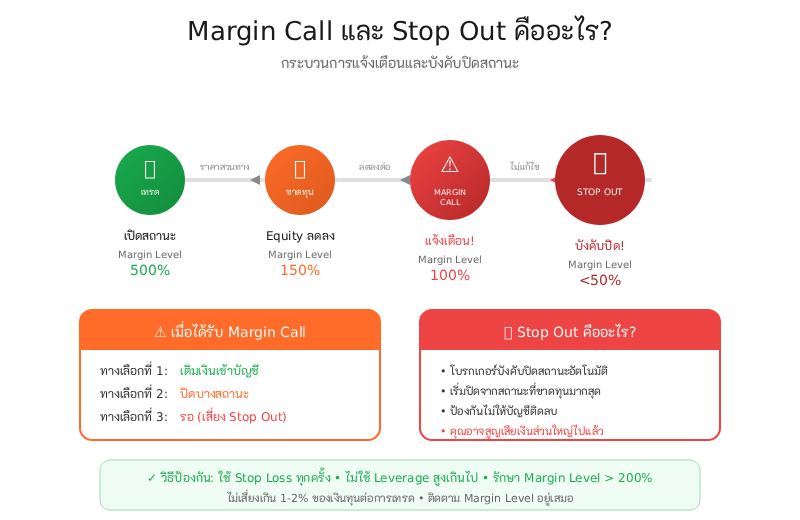
A Margin Call is a warning from the broker that your account’s Margin Level has fallen below the set threshold. It signals that you may need to deposit more funds or close some positions before the broker forces a closure.
A Margin Call occurs when:
- Open positions incur significant losses, reducing Equity
- Margin Level drops below the broker’s specified level (e.g., 100%)
- Free Margin becomes negative or near zero
If the Margin Level continues to fall after a Margin Call without adding funds or closing positions, the broker will perform a Stop Out — forcibly closing positions to prevent the account from going negative.
How Beginners Can Avoid a Margin Call
Ways to avoid a Margin Call:
- Use lower leverage than the broker offers; don’t max out
- Always set a Stop Loss when opening a position
- Do not open positions too large relative to your account balance
- Risk no more than 1-2% of your capital per trade
- Monitor your Margin Level regularly
- Maintain enough Free Margin to cover market fluctuations
Difference Between Margin and Leverage
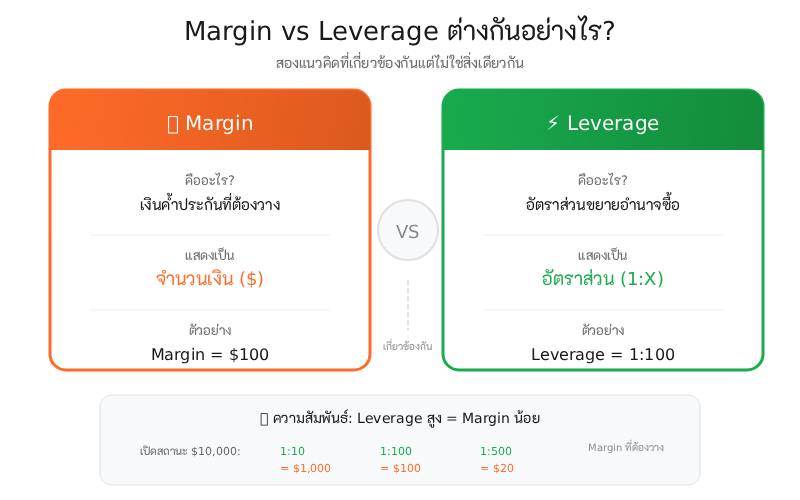
Margin and Leverage are related concepts but not the same. Many traders confuse the two.
| Difference | Margin | Leverage |
| Meaning | The collateral you need to place | The ratio that multiplies your purchasing power |
| Expressed as | Amount of money | Ratio (e.g., 1:100) |
| Relationship | High Leverage = Low Margin | Low Margin = High Leverage |
| Who sets it | Calculated from Leverage | Set by the broker |
Leverage indicates how much money you can control compared to your actual funds, while Margin is the actual money you need to place. Higher Leverage means lower required Margin.
Example for opening a 10,000 USD position:
- Leverage 1:10 → Margin 1,000 USD
- Leverage 1:100 → Margin 100 USD
- Leverage 1:500 → Margin 20 USD
Margin in Other Markets Beyond Forex
The concept of Margin is not limited to Forex but exists in many financial markets and business contexts.
Difference Between Margin in Stocks and Crypto
How does margin differ between stocks and crypto? Both markets allow Margin Trading but with important differences:
| Factor | Stocks (Margin Trading) | Crypto (Margin Trading) |
| Typical Leverage | 1:2 to 1:4 | 1:2 to 1:100+ |
| Regulation | Strict | Less strict |
| Volatility | Moderate | Very high |
| Risk | Moderate | Very high |
| Trading Hours | Market hours only | 24/7 |
Using Margin in crypto is riskier due to high price volatility, and Leverage amplifies the risk further.
What is Accounting Margin?
Accounting Margin refers to the difference between revenue and cost/expenses, expressed as a percentage. It indicates a company’s profitability and is used by investors and analysts to assess performance.
For example, Profit margin is the ratio of profit to revenue. If a company has revenue of 1,000,000 THB and net profit of 100,000 THB, the Profit Margin will be 10%.
What is Marketing Margin?
Marketing margin is the difference between the selling price and the cost of goods. It is often used to set prices and analyze gross profit. It indicates how much profit a business makes from each product sold before other expenses.
For example, if a product is sold at 100 THB and the cost is 60 THB, the Marketing Margin will be 40 THB or 40%.
Types of Margin and Business Metrics You Should Know
In business and finance, there are various types of margins used to measure efficiency and profitability.
What is Gross Margin?
Gross margin is the ratio of gross profit to revenue. It shows how much gross profit remains after deducting the cost of sales.
Formula: Gross Margin = (Revenue – Cost of Sales) / Revenue × 100%
A high Gross Margin indicates that the business is efficient at controlling production or procurement costs.
What is Gross Profit Margin?
Gross profit margin is the same as Gross Margin, just called differently. It represents the ratio of gross profit to revenue and measures the ability to make profit from sales before operating expenses.
What are Net Profit Margin and Net Margin?
Net profit margin is the ratio of net profit to revenue. It is the final indicator showing how much profit remains after all expenses. Net margin is the same.
Formula: Net Profit Margin = Net Profit / Revenue × 100%
Net Profit Margin is highly valued by investors as it reflects overall business efficiency.
Operating Profit Margin and EBIT Margin
Operating profit margin is the ratio of operating profit to revenue. It shows the profitability of core business activities before interest and taxes.
EBIT margin is the ratio of Earnings Before Interest and Taxes to revenue. It is usually close to the Operating Profit Margin but may include other non-core income.
EBITDA Margin and Contribution Margin
EBITDA margin is the ratio of Earnings Before Interest, Taxes, Depreciation, and Amortization to revenue. It removes the effect of depreciation and amortization, showing clearer cash flow from operations.
Contribution margin is the difference between selling price and variable costs. It shows how much each unit sold contributes to covering fixed costs and generating profit.
What are Margin of Safety and Margin of Error?
Besides financial and business contexts, Margin also has other meanings.
Margin of safety is a concept in Value Investing, referring to the difference between the intrinsic value of a security and its current market price. Benjamin Graham, the pioneer of value investing, suggested buying stocks when the price is significantly below intrinsic value to have a “safety cushion” for estimation errors.
Margin of error is the statistical range of potential deviation. Often seen in surveys or research, it indicates how much the result may differ from the true value. For example, “The poll has a Margin of Error ±3%” means the actual value may vary by no more than 3%.
Advantages and Risks of Using Margin
Margin is a tool with both benefits and risks that must be understood before use.
Advantages of using Margin
- Use less capital to open larger positions
- Increase profit potential
- Spread investments further with the same capital
- Access markets that normally require high capital
Risks of using Margin
- Amplifies losses as well as profits
- Risk of Margin Call and Stop Out
- May lose more than invested in some cases
- Psychological pressure from market volatility
- Requires constant monitoring of Margin Level
How to Use Margin Safely for Beginners
If you are a beginner and want to use Margin, follow these guidelines:
- Start with low leverage, e.g., 1:10 or 1:20, even if the broker offers higher
- Do not risk more than 1–2% of capital per trade
- Set Stop Loss every time you open a position
- Monitor Margin Level at all times, never below 200%
- Maintain sufficient Free Margin to cover volatility
- Do not open multiple positions that nearly use all your Margin
- Practice on a demo account before using real money
- Understand the concepts before trading
Conclusion – Is Margin a Tool for Opportunity or Risk?
Margin is both an opportunity and a risk. It allows traders with small capital to access markets and potentially earn more profit, but also increases risk proportionally. The effectiveness of Margin depends on the user, not the tool itself.
For beginners, start by understanding the mechanics, use low leverage, apply clear risk management, and remain disciplined. Knowledge and discipline are key to using Margin safely and effectively.
Frequently Asked Questions about Margin (FAQ)
What is Margin in Business?
In business, Margin is the difference between revenue and cost or expenses, often expressed as a percentage. It measures profitability, e.g., Gross Margin, Operating Margin, or Net Profit Margin.
What does Margin mean?
Margin means “edge” or “difference.” In trading, it is the collateral money placed with a broker. In business, it refers to profit difference.
What is Margin for Beginners?
For beginners, Margin is the money the broker sets aside when opening a position. It is like a deposit held temporarily and does not disappear, locked until the position is closed.
What is a Margin Call?
Margin Call is a broker alert that your account’s Margin Level falls below a required threshold. It signals you to deposit funds or close positions before forced closure.
What is Free Margin?
Free Margin is the remaining money in your account after accounting for used Margin. It can be used to open new positions or withdrawn. Calculated as Equity minus Used Margin.
Difference Between Margin and Leverage
Margin is the collateral money to place, while Leverage is the multiplier of buying power. Higher leverage reduces required Margin.
Difference Between Crypto and Stocks
For Margin Trading, crypto has higher leverage than stocks, more volatility, and less regulation, making it riskier than buying stocks on Margin.
Markets Where Margin Can Be Used
Margin can be used in Forex, Stocks (Margin Trading), Futures, Options, and Cryptocurrency. Each market has different leverage limits and regulations.
You may also be interested in:







Leave A Comment