




Leverage is one of the most important concepts for anyone who wants to trade forex or invest in derivative markets. Many people have heard this term but may not fully understand what leverage is and why it brings both opportunities and risks at the same time. Th-Option has compiled detailed information to help you fully understand how leverage works.
What is Leverage? Meaning of Leverage in Investing
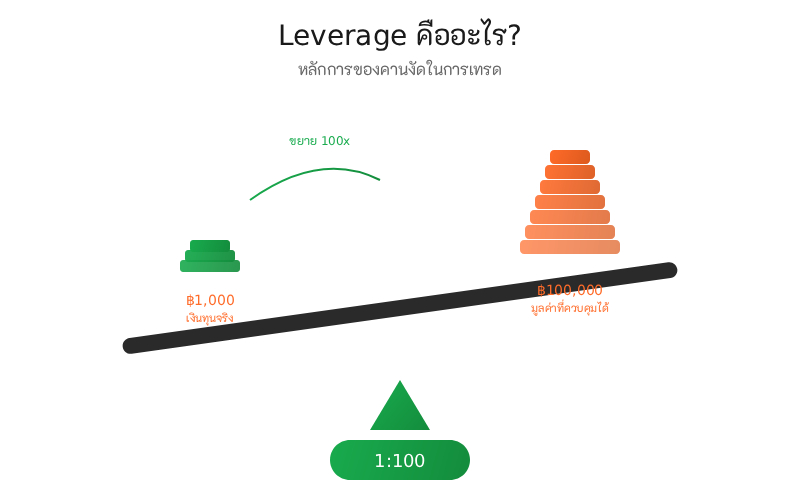
In simple terms, leverage is the use of borrowed money from a broker to open a position larger than your actual capital. Leverage allows you to control a larger amount of money with only a fraction of your own funds. For example, if you have 1,000 THB and use 1:100 leverage, you can open a position worth 100,000 THB.
This concept is not limited to forex markets; it is widely used across many markets, whether it is buying stocks on margin, trading futures, or even investing in real estate with bank loans. All these cases are different forms of leverage.
What Does Leverage Mean and Where Does It Come From?
What does leverage mean? The word “Leverage” comes from English, literally meaning “lever” or “mechanical advantage.” In finance, it refers to using a tool or mechanism to amplify results from the resources available, similar to using a lever in physics to lift heavy objects more easily.
In the financial world, leverage has been used for hundreds of years, dating back to merchants using bank loans to expand their businesses. Today, online brokers make leverage easily accessible for retail traders, which presents both opportunities and risks that must be fully understood.
Simple Example Explaining How Leverage Works
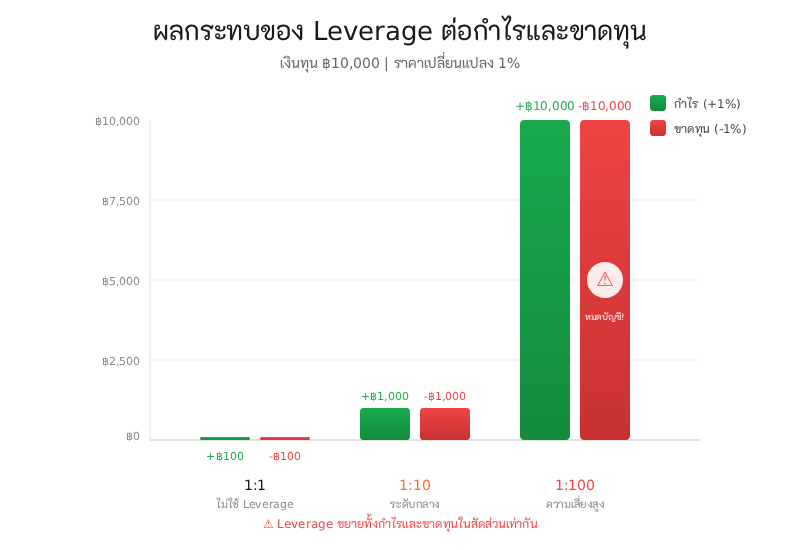
Here’s a clear example: Suppose you have 10,000 THB and want to trade the EUR/USD currency pair.
| Scenario | Actual Capital | Leverage | Controlled Value | Price Up 1% | Price Down 1% |
| No Leverage | 10,000 THB | 1:1 | 10,000 THB | Profit 100 THB | Loss 100 THB |
| Leverage 1:10 | 10,000 THB | 1:10 | 100,000 THB | Profit 1,000 THB | Loss 1,000 THB |
| Leverage 1:100 | 10,000 THB | 1:100 | 1,000,000 THB | Profit 10,000 THB | Loss 10,000 THB |
From the table, you can see that leverage amplifies both profits and losses proportionally. Using 1:100 leverage, a 1% drop in price would wipe out 100% of your capital. This is why it is essential to fully understand leverage before using it.
How Leverage Works in Trading
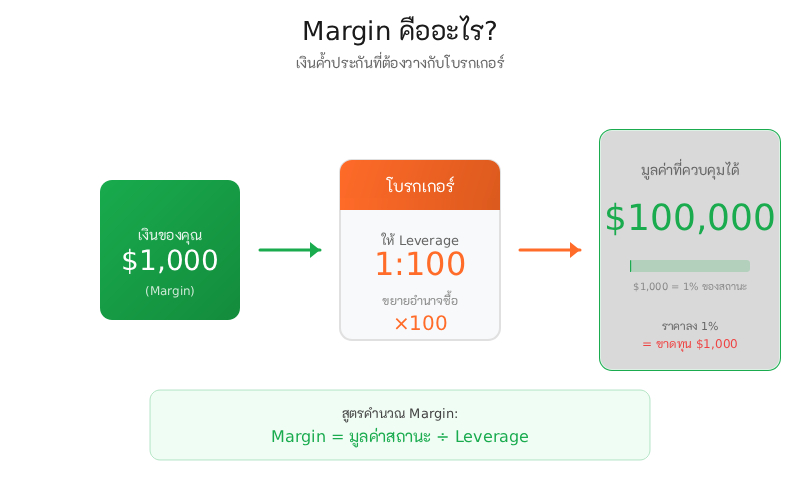
Leverage works by allowing you to place a margin or collateral with the broker, who then permits you to open positions worth more than your margin. Margin is the amount of money you need in your account to open and maintain a position. The higher the leverage, the less margin is required.
For example, if you want to open a position worth $100,000:
- Leverage 1:10 requires a Margin of $10,000
- Leverage 1:100 requires a Margin of $1,000
- Leverage 1:500 requires a Margin of $200
What is Leverage 1:100?
Leverage 1:100 is a ratio that shows you can control 100 units of money using only 1 unit of your own capital. Simply put, if you have $1, you can open a position worth $100, or if you have $100, you can open $10,000.
Leverage 1:100 is commonly offered by many forex brokers. It is considered a medium level—not too high to be overly risky, but enough buying power for most trades. For beginners, this level may still be too high; starting lower is recommended.
How high leverage affects profits and losses
Higher leverage amplifies both profits and losses proportionally. If the price moves in your favor, you gain more, but if it moves against you, losses increase, and they can happen very quickly.
For example, using 1:500 leverage, if the price moves against you by only 0.2%, you would lose 100% of your capital (0.2% × 500 = 100%). This is why high leverage is very risky even with small price movements.
What is Forex Leverage?
Forex leverage is the use of leverage in the foreign exchange market. This market has the highest leverage among all financial markets. Forex leverage allows retail traders to access a market with daily trading volumes of trillions of dollars.
Why is leverage popular in Forex?
Forex leverage is common for several reasons:
- Currency movements are very small daily, usually no more than 1–2%. Without leverage, trading profits would be minimal.
- The forex market is highly liquid, allowing brokers to offer high leverage with manageable risk.
- Broker competition drives higher leverage offers to attract clients.
- Retail traders often have limited capital; leverage helps them access the market.
Is Forex leverage suitable for beginners?
Leverage for beginners must be carefully considered. Using high leverage without experience is a main reason many new traders lose heavily and deplete their accounts.
Beginners should start with low leverage, e.g., 1:10 or 1:20, to learn and adapt to market volatility. As experience and risk management skills improve, leverage can gradually increase. Jumping straight to high leverage is like learning to drive with a race car—high risk of accidents.
Understanding Leverage Ratios
Leverage comes in various levels, suitable for different traders and strategies. Understanding what each ratio means helps you use it appropriately.
What does Leverage 1:200 mean?
Leverage 1:200 means you can control 200 units of money with 1 unit of capital, or Margin equals 0.5% of the position value. For example, opening a $10,000 position requires only $50 margin.
Leverage 1:200 is relatively high, suitable for experienced traders with good risk management. A price move of just 0.5% against you could wipe out your margin.
What does Leverage 500:1 mean?
Leverage 500:1 means you control 500 units with 1 unit of capital, or Margin is only 0.2% of the position value. This is extremely high and risky.
At 500:1 leverage, a price move of only 0.2% against you could wipe out your account. Such leverage is not recommended except for professionals who fully understand the risks and have strict management systems.
What does Leverage 1:1000 mean?
Leverage 1:1000 means you can control 1,000 units with only 1 unit of capital. Margin is only 0.1% of the position value—extremely high and dangerous.
A 0.1% move, or 10 pips in most currency pairs, can wipe out the account. Some brokers offer this to attract clients, but using it should be avoided unless you have a very strong reason and fully understand the risks.
Trading with vs. without Leverage
Trading with or without leverage produces very different results. Understanding this helps decide if and how much leverage to use.
Comparison of returns and risks
| Factor | No Leverage (1:1) | Leverage 1:100 |
| Required Capital | 100% of position value | 1% of position value |
| Profit Potential | Low, based on actual movement | High, amplified 100 times |
| Loss Risk | Low, based on actual movement | High, amplified 100 times |
| Chance of Account Wipeout | Very low | High |
| Suitable For | Long-term investors | Short-term traders |
Example trading scenarios
Assume you have $1,000 and trade EUR/USD.
Scenario 1: No Leverage
- Open a position worth $1,000
- Price rises 1%, you gain $10
- Price falls 1%, you lose $10
Scenario 2: Leverage 1:50
- Open a position worth $50,000
- Price rises 1%, you gain $500
- Price falls 2%, you lose $1,000 (account wiped)
Benefits of Using Leverage in Trading
Although risky, leverage has advantages for disciplined traders.
Increase profit potential with small capital
Leverage allows those with limited capital to access larger profit opportunities. Without it, small traders would barely make significant gains due to small daily price movements.
For skilled and disciplined traders, leverage accelerates growth from small capital—but discipline and skill are essential.
Access large markets
The forex market has daily trading volumes exceeding $6 trillion. Without leverage, retail traders cannot meaningfully access it. Leverage allows trading alongside large institutions even with fractional capital.
Risks of Leverage Beginners Must Know
Leverage is a double-edged sword. Opportunities and risks are amplified. Many beginners lose heavily or wipe their accounts because they misunderstand these risks.
High Leverage = High Risk, True or False?
High leverage does not inherently create risk—how you use it does. Using 1:500 leverage with small positions keeps risk low. The problem is most traders increase position sizes with high leverage, raising risk automatically. Discipline is required to manage high leverage safely.
What are Margin Call and Stop Out?
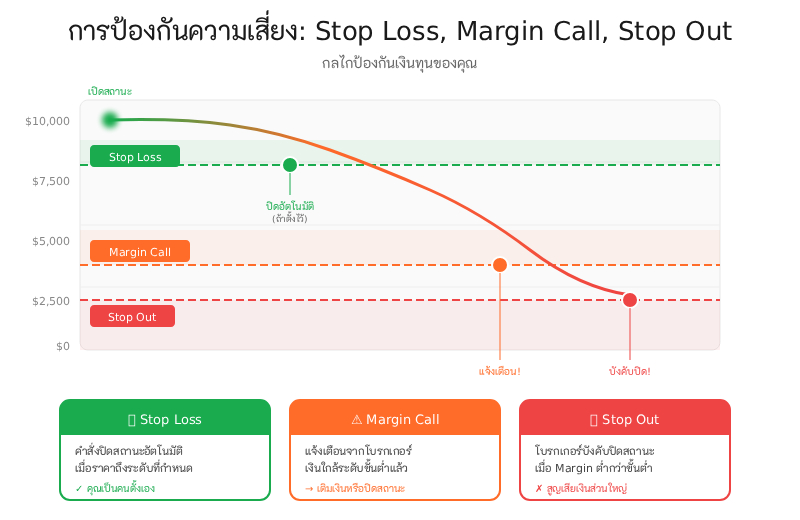
A **Margin Call** is a broker warning that your account has fallen close to the minimum required margin, signaling you to deposit funds or close positions.
**Stop Out** occurs when the broker forcibly closes positions because the Margin Level falls below a set threshold (e.g., 50% or 20%, depending on the broker). This prevents owing the broker money but can result in most of your account being lost.
What Leverage Should You Use? For Beginners and Professionals
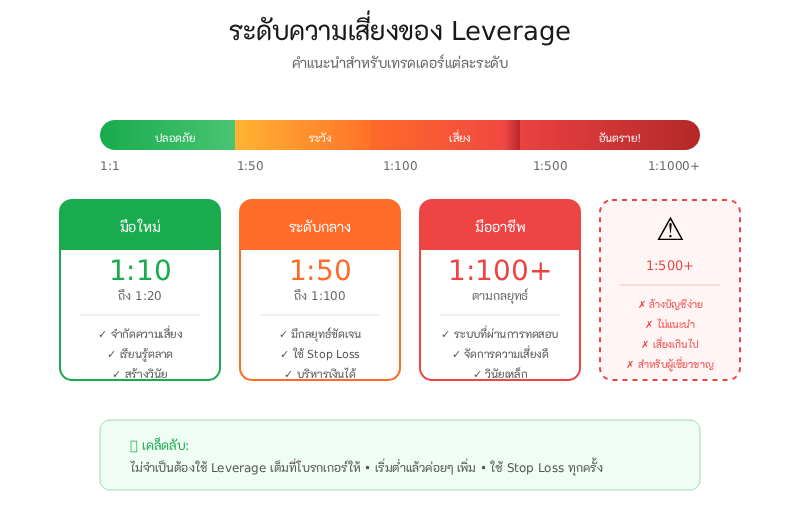
Choosing the appropriate leverage level depends on several factors, including experience, trading strategy, and risk tolerance. For beginners, leverage should be lower than for experienced traders.
Safe Guidelines for Choosing Leverage
- Beginners should start with 1:10 to 1:20 to limit risk
- Intermediate traders may use 1:50 to 1:100 depending on strategy
- Professionals may use higher leverage, but must have strong risk management systems
- Do not use the full leverage offered by the broker; only use what is necessary
Warning Signs You Might Not Be Ready to Use Leverage
- No clear and tested trading strategy
- Never use Stop Loss or use it inconsistently
- Experienced multiple Margin Calls
- Trade based on emotions rather than a plan
- Do not understand how to calculate position size
Risk Management Strategies When Using Leverage
Using leverage safely requires good risk management, not just hoping the price moves in your favor.
Setting Stop Loss
A Stop Loss is an automatic order to close a position when the price reaches a specified level. It is the most important tool to limit risk. Always set a Stop Loss when opening a position, and avoid moving it farther away when the price moves against you.
Managing Lot Size and Capital
A general rule is not to risk more than 1–2% of your capital per trade. This means that if your Stop Loss is hit, you should only lose 1–2% of your account balance. Calculating an appropriate lot size relative to your Stop Loss and capital is a key skill to learn.
Do Not Use Full Broker Leverage
Even if a broker offers 1:500 or 1:1000 leverage, it does not mean you have to use it all. Use only what is necessary according to your strategy and risk management. High leverage does not mean you must use it.
Types of Markets Where Leverage Is Used
Leverage is not limited to forex markets; it is present in various financial markets, each with different characteristics and leverage levels.
Forex Market
The forex market offers the highest leverage, from 1:50 up to 1:1000 or more, depending on the broker and country regulations. It is the market where retail traders can access high leverage most easily.
Stocks (Margin Trading)
Buying stocks on margin typically involves lower leverage than forex, usually 1:2 to 1:4, depending on regulations. Margin trading in stocks carries risk but is lower than in forex due to lower leverage.
Futures
Futures markets offer medium to high leverage depending on the contract type. Oil, gold, and stock index futures have different leverage, generally ranging from 1:10 to 1:50.
Cryptocurrency
Crypto markets offer leverage from low to very high. Some exchanges provide leverage up to 1:100 or more. Due to crypto’s high volatility, using high leverage in this market is particularly risky.
Conclusion – Leverage Is Not Dangerous If Used Correctly
Leverage is like a sharp knife: it can help you create gains if used properly, but it can also hurt if used carelessly. Leverage itself is not dangerous, but using it without understanding and discipline is.
For beginners, start with low leverage, learn risk management, always use Stop Loss, and do not risk more than 1–2% per trade. As your experience and skills grow, gradually increase leverage, but remember even professional traders do not always use full leverage.
Frequently Asked Questions About Leverage (FAQ)
What Does Leverage Mean?
Leverage literally means “lever” or “mechanical advantage.” In finance, it refers to borrowing money from a broker to increase purchasing power, allowing you to control a large amount with a small capital.
What Is Leverage and Who Is It For?
Leverage is a tool to amplify purchasing power, suitable for traders who understand and manage risk. It is not recommended for beginners who do not understand market mechanics.
Is High Leverage Good?
Not necessarily. High leverage offers higher potential gains but also increases risk proportionally. Use leverage appropriate for your experience and strategy.
What Does 1:200 Leverage Mean?
1:200 leverage means you can control 200 units with 1 unit of capital, or need only 0.5% margin of the position value.
What Does 1:1000 Leverage Mean?
1:1000 leverage means you can control 1,000 units with 1 unit of capital, or need only 0.1% margin. This is very high and extremely risky.
What Does 500:1 Leverage Mean?
A 500:1 ratio means you control 500 units with 1 unit of capital. Even a 0.2% adverse price movement can wipe out the account.
What Is Forex Leverage?
Forex leverage refers to leverage used in the currency exchange market. This market often uses high leverage because currency movements are small daily.
What Leverage Should Beginners Start With?
Beginners should start with 1:10 to 1:20 to limit risk while learning. Gradually increase leverage as experience and discipline improve.
You Might Also Be Interested In:
Trading Basics
Trading Strategies







Leave A Comment